

Market Insights / NRI Corner / Buyer's Guide
NRI Guide to Verifying Property in Tamil Nadu Remotely: What You Must Check Before Buying
Buying property in Tamil Nadu as an NRI? This guide covers remote verification, documents to check, power of attorney risks, and how to avoid common NRI property fraud.
NRI Guide to Verifying Property in Tamil Nadu Remotely: What You Must Check Before Buying
You're in Dubai, Canada, or Singapore. Your family back in Chennai or Coimbatore tells you there's a great plot available. The seller is known. The price is reasonable. Your cousin can handle the paperwork.
Stop. Take a breath. And read this before you wire any money.
NRI property purchases in Tamil Nadu are among the highest-risk transactions in Indian real estate — not because of any special legal complication, but because of distance. You can't walk the land. You can't sit across from the seller. You can't visit the Sub-Registrar's Office yourself. And the people you trust to handle things locally may not know what to look for.
The Unique Risks NRIs Face in Property Transactions
Power of Attorney Abuse
Most NRIs must appoint a Power of Attorney (PoA) holder to handle the transaction on their behalf. This is a legal necessity. But it also creates a major vulnerability.
A PoA granted for a specific purpose — like managing a property you already own — can be misused for broader transactions. And fraudsters specifically target NRI-owned properties because they assume the owner is unlikely to discover the issue quickly.
If you're granting a PoA to someone for a property purchase, be very specific about the scope. And if someone presents you with a PoA to act on behalf of a seller, verify that the PoA is valid, current, and not revoked.
Difficulty Visiting Government Offices
In Tamil Nadu, important property records like FMB sketches, A-Register extracts, and certified copies of sale deeds are best obtained from physical government offices. As an NRI, you depend on someone else to do this. That person needs to know exactly what to get — and how to read it.
Emotional Pressure From Family
This is uncomfortable to say but important: some NRI property fraud involves family members. An uncle, a cousin, or a family friend who is trusted to "handle things" may have their own interests. Always have an independent third party verify what you're being told.
Documents You Must Verify for Any Tamil Nadu Property
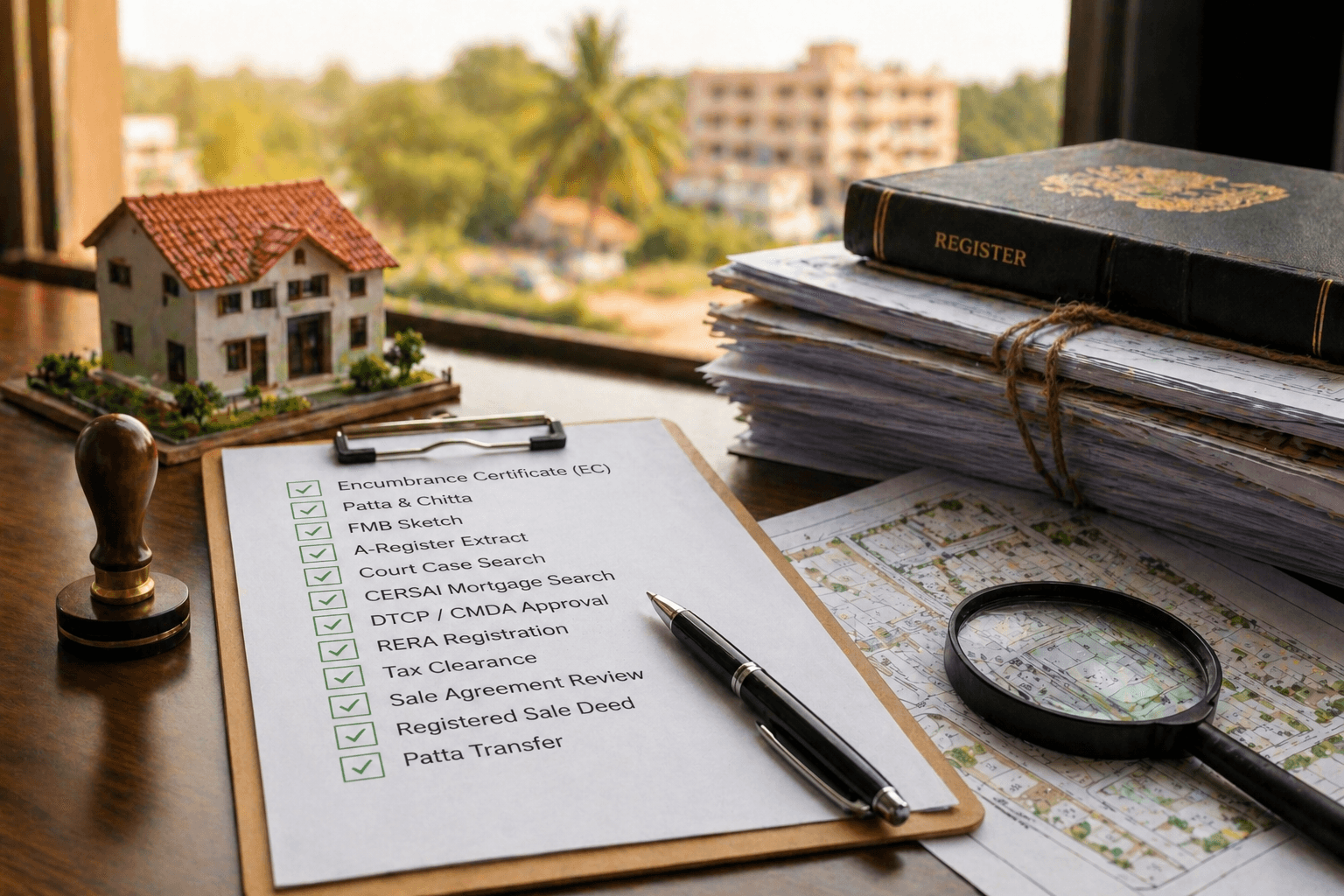
Whether you're buying in Chennai, Coimbatore, or anywhere in Tamil Nadu, these checks are non-negotiable:
Encumbrance Certificate (EC) — at least 30 years. Get this directly from TNREGINET. Don't accept a photocopy.
Patta/Chitta extract — from eservices.tn.gov.in. Confirm the seller's name, survey number, extent, and land classification.
FMB sketch — to verify boundaries and road access.
CERSAI search — to check for equitable mortgages that don't appear in the EC. This is especially important for NRI properties, which are sometimes pledged as security without the owner's knowledge.
Court case search — to confirm no litigation exists on the property or the survey number.
Layout approval — DTCP or CMDA, depending on location.
How to Do This From Abroad
Use Official Online Portals
Several Tamil Nadu government portals now allow online access to land records:
TNREGINET (tnreginet.gov.in) — for EC and registered document details
e-Services portal (eservices.tn.gov.in) — for Patta, FMB, A-Register
Create accounts on these portals and verify records yourself. Don't rely entirely on what your local representative shows you.
Hire an Independent Professional
Even if a trusted family member is coordinating the purchase, hire an independent property lawyer or a professional property verification service to review the documents separately.
LandCheck specifically caters to buyers who cannot be physically present. You provide the property details — survey number, district, and taluk — and receive a comprehensive report covering EC analysis, Patta verification, FMB, CERSAI, litigation, and approval status. NRI customers have repeatedly cited LandCheck as the verification solution that gave them "peace of mind from thousands of miles away."
Video Document Review
Ask your local representative to video-call you and physically show you every original document. Check for:
Document numbers on all sale deeds
Registration stamps and Sub-Registrar seal
Consistency across all documents (same survey number, same extent, same seller name)
Visit Before Final Registration if Possible
If the purchase value is significant — and for most NRIs it is — plan a trip to India before the final registration. Walk the land. Visit the Sub-Registrar's Office. Meet the seller in person. A few days spent on this can protect an investment worth crores.
FEMA Compliance for NRI Property Purchase
NRIs can buy residential and commercial property in India without RBI permission. However, agricultural land, plantation land, and farmhouses are restricted. Ensure the land classified as agricultural in Tamil Nadu revenue records doesn't fall under this restriction if you're buying as an NRI.
For high-value transactions, consult a tax advisor about TDS obligations (the buyer must deduct TDS when purchasing from a non-resident) and FEMA-compliant payment procedures.
Red Flags Specific to NRI Transactions
Pressure to complete the transaction quickly before you can visit India
Reluctance to provide digital copies of documents for your independent review
PoA presented by the seller with unusually broad powers
Property in a seller's name but EC showing no registered acquisition (how did they get it?)
Family pressure to "trust and not ask too many questions"
The Bottom Line for NRIs
Your distance is your biggest vulnerability. Closing that gap requires independent, professional verification — not just the word of your local contact.
→ LandCheck provides remote property verification reports trusted by NRIs across the world. Start your property check at landcheck.in.
View more articles
Learn actionable strategies, proven workflows, and tips from experts to help your product thrive.


